In Part 1 of Instructional Design Basics series, we read about Instructional Design theories. We learnt that Instructional theories provide the basis for an instructional designer to select the best instructional strategy to develop an effective learning experience. Based on these learning theories and science behind the instruction and cognitive behavior of the learner, instructional design models are created. These instructional models help the instructional designers to systematically plan and develop the framework and instructional material to facilitate maximum impact on the learning.

Almost all instructional models are based on ADDIE model and contain Analysis, Design, Development, Implementation, and Evaluation phases. It is based on this model that we have derived the main aim of an instructional designer to determine instructional goals, design instructional strategies, develop instructional materials, and evaluate the success of instructional program.
ADDIE Model
The ADDIE model is based on the behavioral approach and offers a stepwise approach to design, develop, and implement a learning experience in five phases. These phases are Analysis, Design, Development, Implementation, and Evaluation. These five phases encompass the entire process of creating an effective learning program. An Instructional designer analyses the learners’ needs; develops the strategy for the instruction and delivery and evaluates the learning outcomes.

Analysis Phase – In this phase, the need for the training is identified by analyzing the following:
- Learner’s characteristics (existing knowledge, previous relevant experience)
- Learning context and environment
- Business goals and need for the training.
Design Phase – In this phase, the goals and objectives of the training are identified, and course outline and course curriculum are created. It is in this phase that the following decision are taken:
- Instructional strategy for the outlined content
- Training delivery method
- Types of learning activities and media
Development Phase – In this phase, the instructional content is created along with the assessment materials. It is during this phase that the prototype is delivered to the client.
Implementation Phase – In this phase, the instructional material is delivered to the learners in the form of a training program (self-directed or instructor-led).
Evaluation Phase – in this phase, the success of the learning program is assessed through summative evaluation. The formative evaluation takes place at each stage of the design and development process to ensure continuous improvement of the instructional material.
Dick and Carey Model
Similar to the ADDIE model, the Dick and Carey model is also based on the behavioral approach and consists of five phases of Analysis, Design, Development, Implementation, and Evaluation. However, the Dick and Carey model is more detailed and includes more steps in each phase to further elaborate the instructional design process.
The Dick and Carey model consists of the following steps:
- Identify instructional goals.
- Conduct instructional analysis.
- Identify entry behaviors and learner characteristics.
- Write performance objectives.
- Develop criterion-referenced test items.
- Develop instructional strategy.
- Develop and select instructional materials.
- Develop and conduct formative evaluation.
- Develop and conduct summative evaluation.

Let’s look at some of the similarities between the ADDIE and Dick and Carey model. Both the models –
- Are based on the behavioral approach.
- Use a systematic approach in designing the instruction.
- First derive the goals and objectives that form the basis of the design and development of the learning program.
- Include the design and development stages that are derivative of each other.
- Provide the learning outcomes that can be assessed.
4C/ID (4 Components Instructional Design) Model
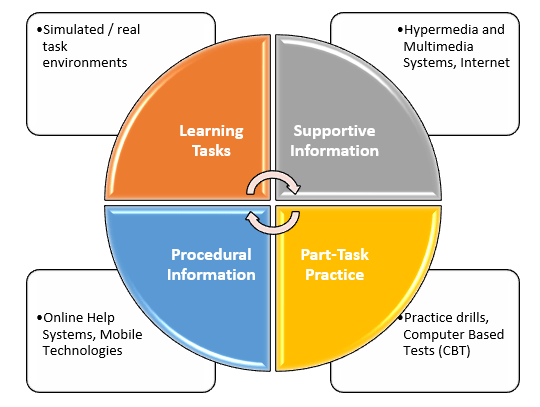
Unlike the ADDIE and Dick and Carey models, the 4C/ID model is based on the cognitive learning theory and is primarily used for designing complex learning programs. The four components of 4C/ID model are:
- The learning tasks are organized in the order of complexity of learning – from highest to lowest cognitive load. This means, more support is provided to the learner in the beginning and slowly the learner is made independent.
- Supporting material is provided to the learner that forms the bridge between the previous knowledge and the new knowledge to be attained. It consists of cognitive strategies and feedback.
- Just-in-time information is provided to the learner to support the learning process, when needed. This includes explanations and corrective feedback.
- Practice sessions are given at the end of the learning program to ensure the new information is retained and the learning outcome is successful.
The Information Processing Model
The Information Processing Model is based on cognitive psychology that consists of three types of memories, which are sensory memory, working memory, and long-term memory. The information from the outer environment enters the sensory memory. If the learner pays attention to it, the information enters the working memory. In the working memory, the learner processes the information that is to be learned and stored for future reference in the long-term memory. Working memory is limited in duration and capacity. Therefore, if the learner does not pay attention to the information in the working memory, the information goes out of the working memory and out of the mind.
It is this processing of information in the working memory, that is the basis of all learning models and concepts.

Maintenance Rehearsal – Rote memorization (short-term retention) passive learning.
Elaborative Rehearsal – Organizing the information into meaningful units, (long-term retention, active learning.
Therefore, the goal of this Information Processing Model is to understand the concept or rote memorization and the process of elaboration to mentally capture the information to be learned.
Gagne’s Domains of Learning
Gagne has recommended five domains of learning that describe different ways we learn using different resources. These five domains are motor skills, verbal information, intellectual skills, cognitive strategies, and attitudes.
Motor skills are used to learn the facts or skills by repeating and practicing the learning object, for example playing any musical instrument or riding a cycle.
Verbal skills or Information consists of the knowledge of facts and principles and is acquired through the organization of content into meaningful context.
Intellectual skills include explanation of basic concepts and rules. The learning of intellectual skills happens through the understanding of prerequisite skills. The types of intellectual skills are:
- Distinguishing concepts (Difference between Hydrophytes and Xerophytes)
- Concrete concepts (What are Hydrophytes?)
- Defined concepts (Classify different types of plants based on their growth environment)
- Rule Learning (how to calculate speed of a car?)
- High-order Rules (Solving puzzles)
Cognitive skills or Strategies are used to develop your internal learning behaviors such as remembering and thinking. These internal learning behaviors or skills are developed by practicing or by reflecting on your experiences.
Attitude belongs to the affective domain and is not acquired through practice. A change in the learners’ attitude is brought upon by modeling human behavior through reinforcement and feedback. It is important to bring a change in the learners’ attitude to support effective learning behavior.
In the end, it is important to understand that to use different types of instructional strategies, you need to understand different domains of learning and learning models. The knowledge of different domains of learning and Instructional models will help you select the best instructional strategy and the corresponding assessment style.
— End of Part 2 —


 Designing Instructions for eLearning
Leave a comment